
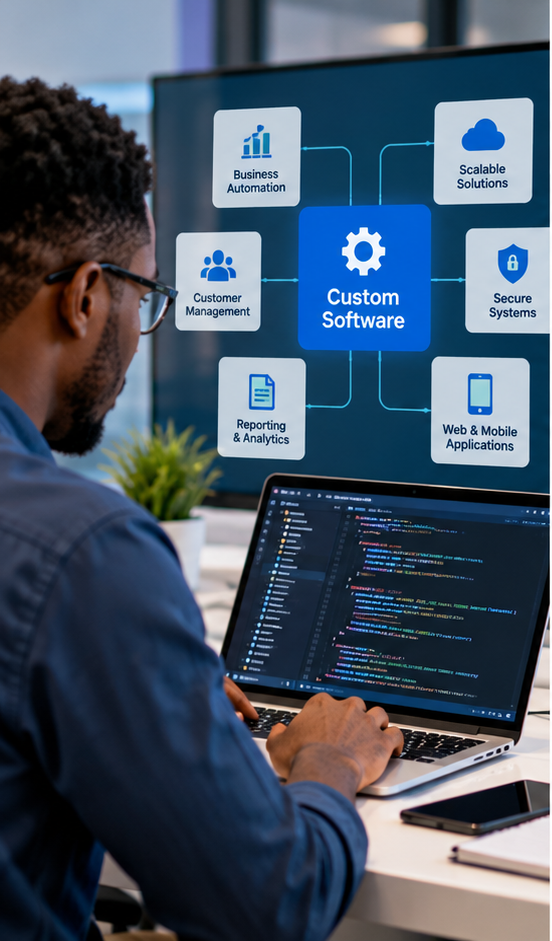
Many businesses begin with simple tools such as spreadsheets, paper records, messaging applications and separate software for different activities. In the early stages, these tools may be sufficient. However, as the business grows, managing everything separately can become increasingly difficult.
Customer information may be scattered across different platforms. Staff may spend hours performing repetitive tasks. Managers may struggle to obtain accurate reports, while customers experience delays because important processes still depend on manual work.
This is where custom software development can make a difference.
At Abexi Digital Technologies, we help businesses explore practical digital solutions, from professional websites and business platforms to custom applications designed around specific operational needs.
What Is Custom Software Development?
Custom software development involves designing and building a digital application or business system to meet the specific requirements of an organisation.
Unlike standard software designed for a broad audience, a custom solution can be structured around your workflows, business model, users and operational priorities.
For example, a school may need a platform that manages admissions, student records, fee payments, results and communication with parents. A hospital may require a system for appointments, patient records, pharmacy operations and billing. A real estate company may need a platform for property listings, enquiries, clients and transactions.
Each organisation has different requirements. The goal is to create a solution that addresses the problems that matter most to that business.
Five Ways Custom Software Can Improve Your Business
1. Reduce Repetitive Manual Work
Repetitive administrative tasks consume time that could be spent serving customers, improving products or growing the business.
A properly designed system can help automate selected activities, such as generating invoices, organising customer information, tracking enquiries, preparing reports and sending notifications.
Automation does not eliminate the need for staff oversight. Instead, it can reduce unnecessary manual effort and allow employees to concentrate on work that requires their attention.
2. Keep Important Information Organised
When business records are stored in notebooks, spreadsheets, email accounts and messaging applications, finding accurate information can become difficult.
A centralised business platform can bring relevant records into one organised environment, subject to appropriate access permissions.
Depending on the system, authorised users may be able to view customer profiles, transactions, appointments, documents and activity histories without searching through multiple unrelated tools.
3. Improve Decision-Making
Business owners need more than assumptions to make sound decisions. They need useful information about their operations.
A management dashboard can present relevant indicators, such as sales activity, outstanding payments, customer enquiries, service usage or operational performance.
When records are accurate and consistently maintained, reports can help management identify patterns, investigate problems and plan improvements.
4. Improve the Customer Experience
Customers expect businesses to provide clear information, respond to enquiries and deliver services without unnecessary delays.
A suitable digital platform can make it easier for customers to discover services, submit requests, book appointments, track relevant activities or communicate with the organisation.
For example, a property platform can allow prospective buyers to explore available listings before contacting an agent. A school portal can give parents access to selected academic or administrative information. A hospital website can help patients understand available services and find contact or appointment information.
5. Support Business Growth
A process that works for ten customers may become difficult to manage when the customer base expands significantly.
A well-planned system can provide a more structured foundation for growth. User roles, workflows, reporting tools and additional modules can be designed around expected business needs.
Scalability should be considered during planning. Simply purchasing or developing software does not guarantee that it will handle every future requirement.
Should You Buy Existing Software or Build a Custom Solution?
Not every business needs a custom application.
Existing software may be the better choice when it already supports your requirements, fits your budget and can be configured without major compromises.
Custom development becomes worth exploring when your organisation has specialised workflows, unique service requirements, integration needs or limitations that existing products cannot reasonably address.
Before making a decision, consider:
- Business requirements: What specific problem must the software solve?
- Budget: What can you invest in development, deployment and ongoing maintenance?
- Ownership and licensing: Who owns the source code, and what usage rights will you receive?
- Integration: Must the system connect to existing software, payment services or third-party APIs?
- Security: How will user access, backups, sensitive records and updates be managed?
- Future needs: Can the solution be extended when your operations change?
A clear requirements assessment can help prevent unnecessary features, unexpected expenses and unsuitable technology choices.
Examples of Business Systems That Can Be Developed
Custom digital solutions can support different industries.
- Healthcare: Hospital management systems, electronic medical records, appointment platforms and administrative dashboards.
- Education: School management systems, student portals, admissions platforms, fee management and result processing.
- Real estate: Property listing websites, agency management platforms, enquiry management and transaction workflows.
- Commerce: E-commerce websites, multi-vendor marketplaces, inventory tools and order management systems.
- Professional services: Client portals, document management, booking platforms and internal workflow applications.
The appropriate solution depends on the organisation's needs, users and available resources.
What Does the Development Process Look Like?
A successful project begins with understanding the business rather than immediately writing code.
- Requirements assessment: Identify the problems, users and desired outcomes.
- Planning and design: Define the features, workflows and interface.
- Development and testing: Build the agreed functionality and test important use cases.
- Deployment: Configure the system and prepare it for real-world use.
- Training and support: Help users understand the platform and establish a maintenance plan.
The scope, delivery timeline and cost should be agreed upon before development begins.
How Abexi Digital Technologies Can Help
Abexi Digital Technologies provides website development, custom software solutions and digital platforms for organisations looking to improve how they operate and serve their customers.
Our approach is to understand your business model, identify the problem you want to solve and determine the most practical digital solution for your requirements.
Whether you need a professional website, a management system, an online marketplace or a platform built around a specific workflow, the first step is a clear discussion of your objectives.
Conclusion
Technology should solve real problems, not introduce unnecessary complexity.
The right business system can help organise information, reduce repetitive work, improve visibility and provide a stronger foundation for growth. The key is choosing a solution that fits your actual needs rather than paying for features you may never use.
Have a business process you want to improve? Contact Abexi Digital Technologies to discuss your requirements and explore a suitable digital solution.
Visit Abexi Digital Technologies to learn more about our services.