
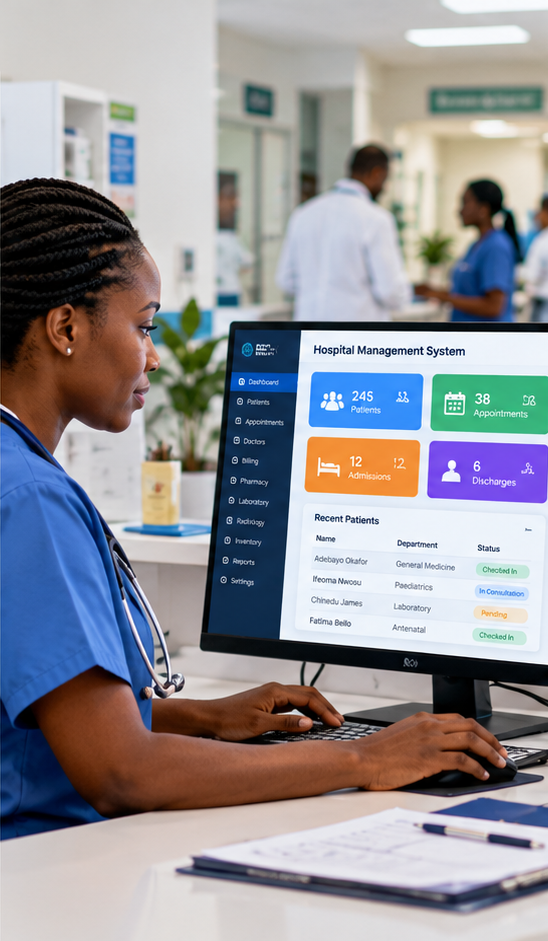
Running a hospital or clinic involves coordinating many activities at the same time. Healthcare professionals attend to patients, reception staff manage appointments, laboratories process investigations, pharmacies handle medications, and administrators oversee billing, records and daily operations.
When these activities depend heavily on paper records or disconnected tools, delays and administrative difficulties can affect the overall patient experience.
A hospital management system can help healthcare facilities organise these activities within a structured digital environment.
For Nigerian hospitals and clinics considering digital transformation, understanding how these systems work is an important first step.
What Is a Hospital Management System?
A Hospital Management System (HMS) is software designed to support the administrative and operational activities of a healthcare facility.
Depending on its configuration, it may bring together patient registration, appointments, clinical documentation, billing, pharmacy operations, laboratory requests, inventory management and reporting.
Some systems also include electronic medical records, staff management, patient portals, insurance workflows and integrations with other healthcare technologies.
An HMS does not replace the professional judgement of doctors, nurses or other healthcare practitioners. Its purpose is to support the processes and information they use to deliver services.
Why Do Hospitals Need Digital Management Systems?
1. Better Organisation of Patient Records
Patient information is central to healthcare delivery. When records are difficult to locate, incomplete or spread across different locations, staff may spend unnecessary time searching for information.
A suitable digital records system can help authorised personnel retrieve patient details, document encounters and review available medical histories.
Healthcare facilities must also establish appropriate policies for record accuracy, confidentiality, retention and access.
2. More Organised Appointment Management
Managing appointments manually can create scheduling difficulties, particularly in facilities with multiple doctors, departments or service locations.
A digital appointment module can help reception staff register appointments, organise schedules and review bookings.
Where supported, reminders and patient communication tools can also help patients receive relevant appointment information.
3. Improved Coordination Between Departments
Healthcare operations involve several interconnected departments. Information about a patient, investigation, prescription or payment may need to move between different teams.
An integrated system can help coordinate supported workflows across reception, consultation rooms, laboratories, pharmacy and billing.
For example, a clinician may document an investigation request, the laboratory may process the request, and authorised staff may record the relevant results in the system.
The benefits depend on whether the required modules are available and properly configured.
4. Better Billing and Financial Visibility
Billing errors and incomplete payment records can create administrative difficulties for healthcare facilities.
A hospital management system may support service billing, receipts, payment tracking and financial reports.
Depending on the implementation, authorised administrators can review outstanding balances, selected revenue categories and transaction histories.
5. More Useful Management Reports
Hospital managers need reliable information to understand service activity and operational performance.
A well-maintained system can provide reports on appointments, patient visits, revenue, stock levels and other supported indicators.
These reports can help management identify operational issues and plan resources more effectively.
However, reports are only as dependable as the information entered into the system and the processes used to maintain it.
Important Modules to Consider
Not every healthcare facility needs every available feature. The right configuration depends on the facility's size, services, budget and existing workflows.
- Patient registration: Records patient details and supports patient identification.
- Appointments: Organises schedules, bookings and selected reminders.
- Electronic medical records: Supports clinical documentation and access to authorised patient information.
- Pharmacy management: Helps manage medicines, dispensing records and stock, depending on the implementation.
- Laboratory management: Supports investigation requests, result recording and related workflows.
- Radiology management: May support imaging requests, reports and coordination with imaging departments.
- Billing and payments: Records charges, invoices, receipts and payment information.
- Inventory management: Helps track selected medical supplies, consumables and other stock.
- User and staff management: Defines accounts, roles and permissions.
- Reports and dashboards: Presents operational information to authorised users.
Before selecting a system, confirm which modules are included in the proposed package and which require additional development or integration.
How Much Does a Hospital Management System Cost in Nigeria?
There is no single price that applies to every hospital management system.
Costs can vary according to the number of modules, facility size, number of users, data migration requirements, integrations, training, hosting and support arrangements.
A small clinic with basic registration, consultation and billing requirements may need a different configuration from a specialist hospital with several departments and more complex workflows.
When comparing proposals, consider the full cost of ownership rather than only the initial installation fee.
Ask whether the quoted price includes:
- Installation and configuration.
- Domain and hosting, where applicable.
- Staff accounts and access permissions.
- Initial training.
- Data migration, if required.
- Maintenance, updates and technical support.
- Additional modules or third-party integrations.
- Annual renewal fees, where applicable.
Also clarify whether the arrangement is a one-time software purchase, a subscription or a customised project with separate ongoing costs.
Security and Patient Confidentiality Must Come First
Healthcare information requires careful protection.
Before deploying a hospital management system, a facility should evaluate how the software handles user authentication, role-based access, backups, secure connections, activity logs and recovery after technical failures.
Only authorised users should access the information required for their responsibilities. Staff should receive appropriate training on confidentiality and secure system use.
Hospitals in Nigeria should also assess applicable data protection obligations, including relevant requirements under the Nigeria Data Protection Act and guidance from the Nigeria Data Protection Commission.
A software installation alone does not guarantee compliance or complete security. Facilities need appropriate policies, responsible administration, secure configuration and ongoing maintenance.
How to Choose the Right HMS for Your Facility
Use these questions when assessing available solutions:
- Does the system support our actual clinical and administrative workflows?
- Can we enable the modules we need without paying for unnecessary features?
- Can staff learn to use the interface comfortably?
- Does the provider explain how data is protected and backed up?
- What happens if the internet connection or hosting service becomes unavailable?
- Can the system support additional departments or users in the future?
- What training, maintenance and technical support are included?
- What are the initial and recurring costs?
Request a demonstration using realistic scenarios. Evaluate how the system handles patient registration, consultations, billing, pharmacy operations and reporting where these features are relevant.
It is also useful to involve representatives from the departments that will use the software daily.
Implementing an HMS Successfully
A hospital should not treat implementation as a software installation alone.
Start by documenting existing processes and identifying where delays, duplication or information gaps occur. Agree on the modules required for the first phase, assign responsible staff and prepare a training plan.
Where practical, test the system with a limited group of users before expanding deployment. Establish procedures for correcting inaccurate records, reporting technical issues and managing access when staff roles change.
A phased implementation may help the facility adapt gradually, provided that patient safety, operational continuity and data integrity remain priorities.
How Abexi Digital Technologies Supports Healthcare Facilities
Abexi Digital Technologies offers digital solutions for healthcare organisations, including hospital management systems and professional hospital websites.
We help facilities explore technology options for organising patient administration, appointments, records, pharmacy, laboratory workflows, billing and other operational activities, depending on the agreed system scope.
Our approach is to understand the facility's requirements, identify the necessary modules and discuss deployment, configuration, training and support arrangements before implementation.
Whether you operate a clinic, specialist hospital or a growing healthcare facility, the appropriate solution should reflect how your organisation works.
Conclusion
A hospital management system can help healthcare facilities organise information, coordinate supported workflows and improve operational visibility.
The best choice is not necessarily the system with the longest feature list. It is the solution that fits the facility's requirements, can be used effectively by its staff and is supported by responsible security and maintenance practices.
Planning to digitise your hospital or clinic? Contact Abexi Digital Technologies to discuss your requirements and explore a suitable hospital management solution.
Visit Abexi Digital Technologies to learn more.